The day I decided to apply for a master's was one of those evenings I can only describe as buried in paperwork. I opened a fresh Notion page and, item by item, turned everything in my head about a design master's into an execution checklist. These days you could do it faster — have Claude run a web search and write the whole thing up in markdown within minutes — but I still believe the tools only change how efficiently work gets done; the quality, at least for me till today, still relies on human decisions.
This is for anyone who is considering or preparing for an application to RCA Service Design. It is not another of those breezy "I got in, so here I am to share the joy" posts, but quite the opposite. Throughout the application I was weighing one uncertainty against another, every step chained to the upcoming ones, if either my military service (compulsory in Taiwan) or the scholarship had fallen through, I would have immediately dropped the master plan. (yep puns intended)
I'm updating this in 2026, looking back at my notes from the time. Also please be noted that I was bound by the terms from Y.L. Lin Scholarship, by which I could only apply to one single school. Many of the decisions below were made on a "now or never" premise — if you're applying to several schools in parallel, your strategy will look very different. As for how I ended up applying for a design master's from a business background, that story is in From Business to Service Design.
How I Got Into RCA MA Service Design
Here's the whole run — from choosing the programme to the offer, in the order it actually happened.
12–9 Months Before: Choosing the Ideal School
How I chose — the Criteria and Leverage
If you're stuck on "which schools should I apply to", I set the schools aside at first, and looked instead at the wider market — even the country itself — of how seriously the general public and government take the design industry. These are the dimensions I worked through:
- Programme length — 1 year in the UK, 2 in the US, and in most of Europe about 1.5 years aka eighteen months. Factor in the opportunity cost (a year of salary forgone, visa years, age), alongside total tuition, eventually I chose the UK.
- Industry ecosystem — service design is a concept that was scaled in the UK (though originally introduced in the US). The density of design consultancies, how receptive the public sector is to design, where graduates end up working — after chatting with a few alumni, I settled on the UK.
- Course philosophy — RCA SD leans research-led, social-impact oriented; UAL (LCC) takes a more "creative" route; Kingston leans product/UX. I'd always wanted to know how the UK's public sector — Policy Lab, the BBC — actually does design, so RCA it was.
- Learning resources — going through past graduates' projects (there used to be an RCASD site showing the 2021–2022 graduate work; nobody maintains it now), RCA's industry resources turned out to be extensive and wide-ranging.
To be honest, RCA tuition is undoubtedly expensive. The year I enrolled it was £33k — a one-year, full-time course, 180 credits, three terms across forty-five weeks. (Just saw that for 2026 it has gone up to £37,750…)
On top of that, my year started with the change of Head of Programme — the previous lead, Clive Grinyer, announced he was stepping down, right three days after we'd registered. Our whole cohort was deeply disappointed by the decision.
The more dramatic part: the position then remained vacant for about three to four months, and it wasn't until the second term that the senior professor, Qian Sun, took on the Head of Programme role.
9–6 Months Before: Preparing the Materials
RCA's master's applications go through the school's online Applicant Portal; each cycle has four rounds with rolling basis, closing as places fill up. What you need to prepare at this stage:
- Portfolio — three to five files
- Personal Statement — 300 words
- Study Proposal / Interest of Research — around 1,000 words
- Motivation Video — under two minutes (after researching the other schools, I found this is RCA-specific)
- References — the school contacts your referees directly (so they say, though I'm fairly sure they never did)
- English proficiency — non-native speakers need IELTS 6.5, no component below 5.5
Portfolio
I am not from a design background, so this was the step I struggled the most — a long stretch of agonising before I shaped it into a version that fit me. The materials I applied with can be seen on my projects page, though most of them are outdated for a while.
What my portfolio held wasn't beautiful visual work — it was project records, packaged in a designer's storytelling.
For non-design applicants, the crucial part is never "pretending to be a designer", it's the framing — deconstructing what you've already done and showcasing them again in the language of design:
- research you've done = user research / contextual inquiry
- proposals you've written = service blueprint / journey map / opportunity area
- collaboration you've led = stakeholder management / co-creation
- problem breakdowns you've done = problem framing / systems thinking
Not cramming design terminology onto your projects — narrating your own experience as though you were a designer, in a way that your audience, the faculty from the programme, can understand.
Side note, I come from a business background — rare among the applicants at the time (I did a little research after enrolling), which may have been part of the reason why I was accepted. But I'd say what service design values, is that whether an applicant can solve problems in the real world, rather than making pretty decks; with that thought and viewing from hindsight, a business background is an asset rather than a liability. (for those who concern about backgrounds)
If you're also from a non-design background, don't spend your energy imitating designer visual language — that gap is exactly where the difference comes in.
I went for the most unglamorous narrative, the double diamond Design Thinking framework: what was the problem → how did I research it → what was the insight → what did I design → what came of it. The projects I selected include the community-organising behind No Design (ND), the Songshan Cultural and Creative Park sustainability project, a brand-refresh project I coached a team through at TR Lab, and another system design project.
RCA officially listed out the ideal candidate quality they seek: whether your project challenges what already exists, whether it draws real insight out of user research, whether its creativity goes beyond the expected, and whether it shows an understanding of implementation and delivery. Check every project with these four dimensions and ask whether you can provide evidence along each of them — that's most of the job.
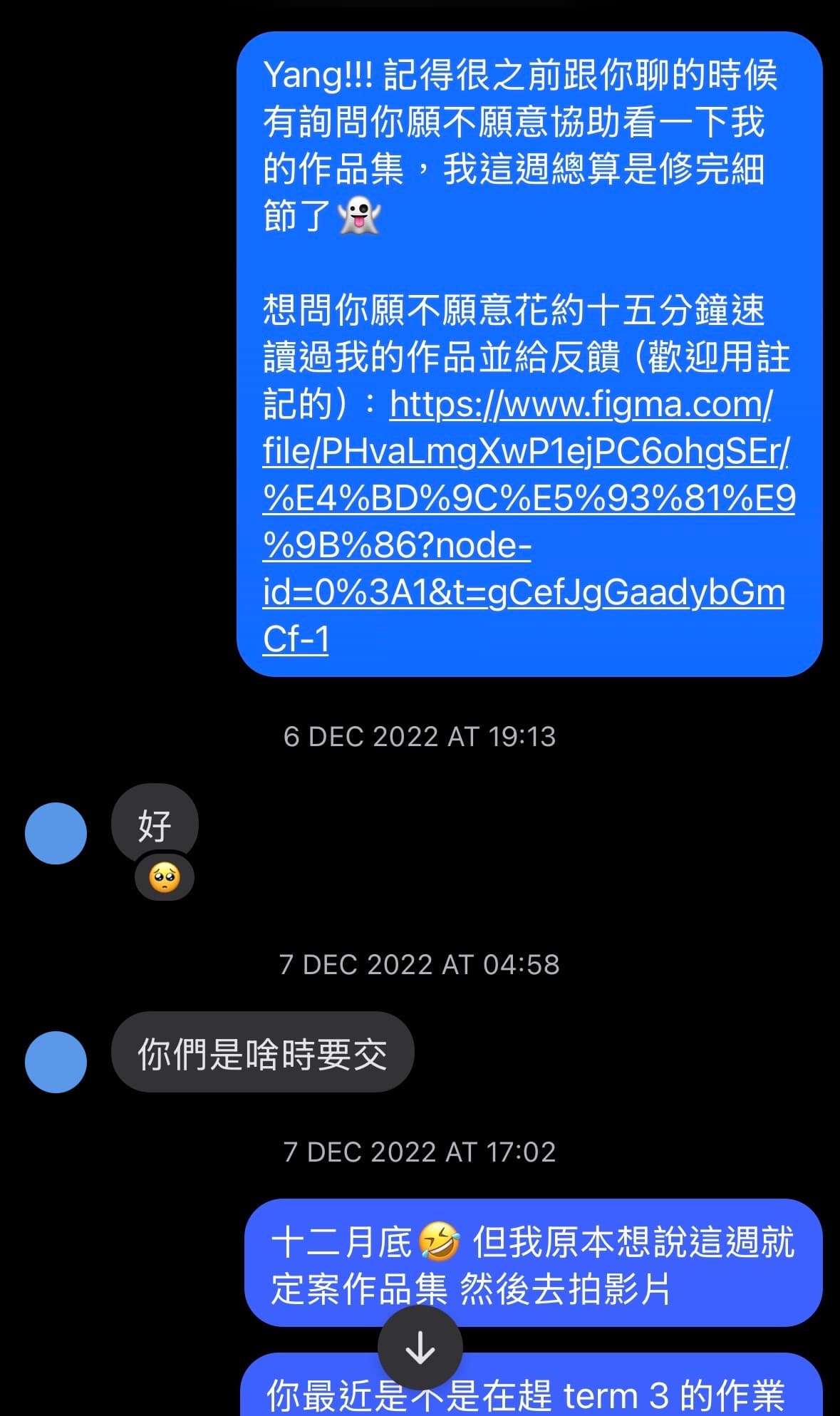
I also learned a huge amount from Yang, a graduate of the year above who got into SD from a civil engineering background.
Personal Statement
It's simply stating your background and motivation, clearly and briefly, written as though you were already an RCA student. My structure:
- Opening — your thesis statement including who you are, what you care about, why you're here. This anchors the whole piece.
- Evidence — one or two specific experiences that support the thesis. Don't list everything; pick the one or two that stands out.
- Why here — don't write "RCA is famous". Be specific: which faculty member's research, which module, which direction.
- Closing — what you plan to do next: where you intend to take this capability once the course is done.
300 words is very limited; every word has to earn its place. Once I'd finished, I asked three seniors — Jess, Hortance and Yang — for revise suggestions, my first two were a complete disaster. Here is the final version for submission:
Bring design to the public sectors for better experience has become my pursuit since 2020. My exploration began with the foundation of No Design, where I initially crafted contents about design tools. As the time went by, it had transformed into a community of "design learners", which prompted me to try applying Service Design tools to engage the team to iterate services.

My business background equipped me with quantitative thinking, but I found qualitative insights important as we did more campus-wide projects. Overlooking user insights often lead to a decontextualized result, mishitting the problem. I found SD's process of delivering feasible solutions with both research methods rewarding, which I initially as a result-driven person had never thought about.

"Delivery" is my favorite part of SD. I am good at generating diverse solutions. I planned the ESG strategy for Songshan Cultural and Creative Park over 50 case studies and workshops for experts, the proposal was accepted and implemented into client's three-year plan. Building NTU project platform, I guided designers and engineers through 4-month agile development, with the product reaching a peak of 5,548 daily views and an average usage of 167 within three months.

These experiences paved my way to a promoter of design, and the UK's successful cases of integrating design, public policy and business would further extend my journey. RCA's courses like Social Enterprise and Design Entrepreneurship would equipped me well for my vision as a venture architect or design consultant, along with the Social Impact Lab and real projects, I could utilize both quantitative and qualitative skills to collaborate with inspiring fellows, combining my business sense with learning of SD to create impact. As an initiator with diverse experiences, I believe I will not only thrive but also bring diversity to this marvelous environment.
Study Proposal (Interest of Research)
Every school asks for a research proposal, or similar format but with a different name. As I recall, RCA named it the Interest of Research — around 1,000 words, submitted with the application as an initial concept for the project you'd want to work on later.
This one, honestly, just surfaced out naturally once I'd finished organising my portfolio. Again, the final version:
Drive Digital Transformation in the Public Sector with Service Design: Methodology & Toolkits

Through the training of MA in Service Design, I will be able to solve problems with design mindset and methodology, providing a systematic solution that fits stakeholders' needs. Cultivating a overall integrated perspective viewing things, I will bring the business thinking and solution-driven sense back to Taiwan, back to the design team No Design which I founded in 2020. Utilizing the success experience of integrating design to the public sector, I hope to eventually deliver a digital transformation model or SOP that fits Taiwan.

For my study plan, I choose to take business- and innovation- related courses, aiming at gaining the most from the UK's success cases of business innovation driven by design. Along with the projects, I will be able to actually work with the locals to get the knowledge of implementation, then further transform it into a form that fits Taiwan. As an NTU alumni, I will be able to push forward the transformation on campus, utilizing my advanced learning from MA Service Design.

Internship between semesters is also included, leading companies like IDEO and BCG Digital Venture are my targets, I will be able to gain first sight on how business transformation is implemented. Besides, I am also looking forward to take advantage of the external project partnership, which is still lacking in Taiwan, and make changes with other abundant resources provided by the school. With such an opportunity, I believe I will not only thrive but also bring diversity to this marvelous environment.

## Origin & Goal of Research

Bring design to the public sectors for better experience has become my pursuit since 2020. My exploration began with the foundation of No Design, where I initially crafted contents about design tools. As the time went by, it had transformed into a community of "design learners", and we collaborated with NTU authority to push the school systems through digital transformation, including the online course selection system, grading and ranking backstage system and the student enrollment websites.

During the collaboration, not only the experience prompted me to try applying Service Design tools to engage the team, but also made me realized that the SD toolkits come in handy when communicating and visualizing the product and service to our key stakeholders, including the clients. Since then, I have determined myself to pursuing the best way of communication in the public sector.

## Rationale

### Importance of Research

Owing to the announcement of Future NTU and the establishment of the Ministry of Digital Affairs, we could see the force driving the transformation from schools to the entire public sector. However, there are still gaps between now and then. The resource limit of the government, the strict regulations for fear of corruption and the traditional idea towards design…etc, these problems are still hindering those who are ready to push through the transformation.

[Ref: https://www.future.ntu.edu.tw/_files/ugd/ce2d16_c4058bd8fd1541348078fc202465bfd4.pdf]

In my experience revamping system on campus, the encountered challenges include the necessity of meeting both the majority's and the minority's needs, no big changes considering the users might fail to switch. These problems had me wondered once the scope was scales up to a national level, how should we adjust in order to face the numerous stakeholders' needs and also keep the system functional. It is critical to find a way to smoothly drive digital transformation in the public sector.

### Project Stakeholders

[Image: Personal Portfolio]

A brief study and desktop research have been conducted and the relation between stakeholders have been mapped out. My research would possibly affects different agencies in the design industry, both private companies and public sectors, by serving as the bridge between individual freelancers and agencies. I hope to develop a long term relationship the two, creating a sufficient resource flow to drive even more transformation to land in the public sectors and local businesses.

## Approach & Timeline

### Major Planning - Double Diamond Process

The research planning of this project were organized by the Design Council's double diamond method which combines divergent and convergent thinking to reach a desirable design outcome. This process was used since it is effective in scoping design projects with systemic problems—such as digital transformation in the public sector.

[Image: Course Diagram]

The overall timeline of the major project would start from week 23 to week 43, and be divided into 3 parts: 23-30 for proposal and desktop research, 31-36 for main research, 38-43 for iteration and prototype.

### Qualitative Research - In-depth Interview & Catagorization

The research would mainly base on the stakeholders' feedback from interviews. The interview result would thereby be organized and categorized by methods like the KANO model or the service safari map.

[Image: Personal Portfolio]

The service safari analyzed key themes in these services and organized them as such. The figure are often identified on two scales, the x-axis and the y axis, each representing different meanings. We often catagorize the qualitative findings into groups and further identify the relationships between groups with the aforementioned methods.

### Stakeholder Engagement - Co-creation Workshop

[Image: Co-creation Workshop / Toolkits]

The co-creation workshop focused on understanding the true process on how stakeholders process services or products. During the session, developing product and service prototype are often built in order to generate a more in-depth and real-time react from users. Held by service designers, we can easily mapped out the activities and identified the main driving force in each step of the process.

## Possible Outcomes

[Ref: https://www.tdri.org.tw/41656/]

A toolkit, report or guide on how to actual land digital transformation in public sectors is expected to be developed, covering aspects like common problems encountered and ways to solve, guideline when building a national or large scope system, usability test and how to conduct it…etc.

[Ref: https://designsystem.digital.gov/]

The possible outcome should undergo the co-creation workshops with staffs from public sectors to make sure it is understandable and usable, and the result is expected to be repeatable for further reproduction and usage of the toolkit or the report. Digital forms such as a website or internal system is also considered, a guideline website like the USA governmental design system website is a great example on indicating the officially rules admitted when building a digital system.
Motivation Video (RCA-specific)
Most service design / HCI programmes don't ask for a video; this one is specific to RCA. I guess this replaced the interview stage which was held in previous years.
My first take was stiff, like reading off a script; the second ran too long, past three minutes; the final cut came in at about two minutes and covered three things — why service design, why RCA, why now. It actually came together faster than I expected. Two things to keep in mind:
- Look into the camera — my trick was writing the key points as "keyword post-its" stuck right above the screen
- Tie everything back to your motivation and research intent, ideally it echoes
*I genuinely can't find the original video file — I'll update this later on
Reference Letter
I asked Kevin, my boss during the DreamVok internship, to write the reference letter for me. A referee who really knows you and can tell specific stories about you is crucial, it matters more than a big name who barely knows your work.
Your referee doesn't need to be from design — what matters is that they can say "this person did X in this specific situation and demonstrated Y", rather than praising you abstractly.
When you contact your referees, give them plenty of time (at least two weeks), and attach your CV, a summary of the programme you're applying to, and the two or three things you think they're best placed to vouch for. If they're busy, you can perhaps draft up a first version for them to polish — the less work you leave them, the better the letter you'll get. (This may not apply for every country or school though)
*Out of privacy, I'm not attaching the letter itself
6–3 Months Before: Submitting
IELTS
The requirement for non-native speakers is IELTS 6.5, no component below 5.5. If you're reading this till this end I guess you'd be fine.
RCA submission rounds
RCA runs rolling rounds; the first usually opens in October or November, the last in April or May. Scholarships generally consider applicants from the first and second rounds, so the earlier you submit, the better.
Scholarships
My own tuition was covered by the NTU Y.L. Lin Scholarship — I'll share the application experience for that programme separately. RCA itself offers a range of scholarships, also on a rolling basis; as I recall, Round 1 and 2 submissions get priority consideration for the President & Vice-Chancellor's Scholarship, and the scholarships aimed at specific backgrounds (GREAT, Sir Frank Bowling and so on) are all listed on the official site.
3 Months Before & After: Confirming
With everything submitted, what follows is a long stretch of waiting. Fast-forwarding through it:
- The 5-week window from offer to acceptance
- 2023-02-15: the notification arrived — I saw it during phone time the day after enlisting, and was over the moon
- 2023-03-22: acceptance tasks (uploading documents in the portal, paying the holding deposit)
- Deposit + tuition in instalments
- £2,000 holding deposit to hold your place
- Tuition split across two payments (50% before enrolment + 50% in January), paid after registration
- Visa timeline
- The visa application can only be submitted three months before enrolment — the actual preparation schedule and documents.
One Last Thing
The application itself isn't the hardest part. What matters more is being clear, during the process, on why you're going and what you've prepared to face — working out who you are amid the thousand loose threads.
People say applying for a master's pushes you to know yourself better, I agree. It was during the application that I looked back over the path I'd taken, and looping back and connecting the dots, eventually traced out how I moved from business into service design.
Final words, I received an enormous amount of help along the way — partially also because I've reached out to at least 20 people, but still. If you have any questions, you're more than welcomed to reach me through Substack or No Design socials!
The other sources I referenced (mostly in Mandarin but I guess now with AI you can search up everything lol):
- School Selection
- Application Process
- Welcome to the Royal College of Magic — 01: Application | Hortance | Rolling in the fog
- Studying design in London: how I got into the Royal College of Art - EVERYDAY OBJECT
- Pearl Shi – Medium (Chevening, IELTS prep)
- A non-straight-A student's very detailed 2020 Fall HCI/UX US grad application recap | Kay Zeng | UX Pacer
- Portfolio Preparation