This piece is last updated in 2026, in my second year of post-graduate working life — a retrospective view of my journey from business school into design, on the jobs I took along the way, and on the handful of decisions I made.
Prof Chu used to say — if Introduction to Management in freshman year was the appetiser, then Strategic Management in senior year would be the main course, the culmination of four years in the College of Management.
One Thursday afternoon in sophomore year, in Wen-Yi's (that's our name for her instead of Prof Chu) Strategic Management class, I was sitting in the very back row of room, listening to her walking through Porter's Five Forces at the front.
The air-conditioning vent above me was cranked low that day; the slide showing the diagram of the Five Forces was in a faded white with the undertone of blue, my note-taking app was full blank, whilst everyone around me was crazy jotting down notes, onto the thick stacks of case studies handed to each of us first start of the lecture.
Wen-Yi paced across the front of the room, hands moving in the air, taking us from a sketch of Sweden's national conditions all the way through to the founder of IKEA's origin story, dispatching the arc of IKEA's global expansion in a crisp fifteen minutes. She was the kind of professor who left you sitting in the room thinking, my god, is this what mastery of a theory and frameworks looks like? That contagious clarity paired with real teaching devotion was rare in the College of Management.
That class was one of the few I willingly attended from start to finish for the entire term, and one of those which I can still recite partially even till today. But even so — with much eagerness stepping into the course, every time I sat in that classroom in senior year, often I found myself carrying an unnamed anxiety about the future which I could not foresee, with an unsettled attempt to sketch it out using whatever mould was to hand.
Compress the anxiety of an uncertain future into concrete fear — that way, you can face it with courage. (A line I heard recently that I love.)
Framework Being the Formula
NTU Business Administration, GPA 3.74. It sounds like a textbook path. In freshman and sophomore years we all followed the syllabus — accounting, statistics, economics, management — each of them taught me a different way to decompose problems, build frameworks, arrive at decisions. Looking back, the College of Management's training was thorough, the four years of coursework (brainwashing might as well said) handed me a full toolkit for analysing the world.
But rewind back to me sophomore spring, I constantly felt a void for knowing things.
To fill up that emptiness, I started to take a lot of courses outside the college. Over time I realised it wasn't the courses themselves — it was the atmosphere around me, the "grinding for the sake of grinding" vibe among my course mates had begun to exhaust me. On one hand I had to deal with my own anxiety about an unknown future; on the other, I always slightly felt being let off by the sort of Chain of Disdain inside the college itself.
Most of my classmates had never really asked themselves what they wanted to do, what they liked, what they didn't — they just stuffed their résumés into the big names because the path was safe (in hindsight, yes, a Big Tech name is a very efficient boarding pass). I knew the upside of a fancy internship — I had thrown my hat in more than once — but every time I filled in one of those applications, something felt off.
I was also coming to terms with the fact that I am a slightly contradictory person: I care about beauty and I care about efficiency; I love the precision of numbers and I love the interpretive openness of words.
The deeper layer was this: the College of Management taught me frameworks and how to analyse, but never where those frameworks came from or why they existed. It also trained every student to become an operator whose only job is to apply the framework — and so, structurally, we were all cogs on a Taylorist production line, forever unpacking and repackaging the residue of knowledge that had already been chewed over, once again.
The tools could analyse markets and dismantle strategies — but they could not answer a more fundamental question: what is all of this ultimately for? A business model canvas draws a lovely nine-square grid, but the "customer" inside is just an abstract label. I wanted to get closer to the person behind that label — to understand their situation, their feelings, why they made the choices they did.
Management, as an academic discipline, is essentially a meta discipline — it distils "success formulas" from the experiences of major winners and spectacular losers, and that has always been its foundational move. What first pushed me away was a disgust for the competition-through-capital that the field kept celebrating. Round and round, and here I am now working in the venture-capital-fuelled startup world.
On Design, and on Not Being a Design Major
In sophomore year I did one thing — I started a community called No Design (ND).
NTU has got no design school, but there was a scattered group of people across different departments who cared about design. I gathered them, and together we ran several projects — feeling out what user research was, what a prototype test was, how to define a problem from a person's actual needs.
Around the same time I began freelancing — starting with social media and brand consulting, then software systems and brand research on the commercial side, learning as I went. Clients wanted deliverables, but I always wanted to dig one layer deeper: why should this brand position itself this way? Why would these users be moved?
Perhaps I hadn't got trained as a designer, and to this day I have never drawn a GUI or a wireframe by hand — coupled with my business background that always nudged me to ask can this even hold together, I gradually noticed that my understanding of what design was diverged, in meaningful ways.
It was not until much later, when I was in London looking back, that I realised: design is not only about aesthetics — it is a way of seeing. And what it changes is not just the form or the granularity of what you build, but the way you look at the problem.
The Digital Transformation of the Public Sector
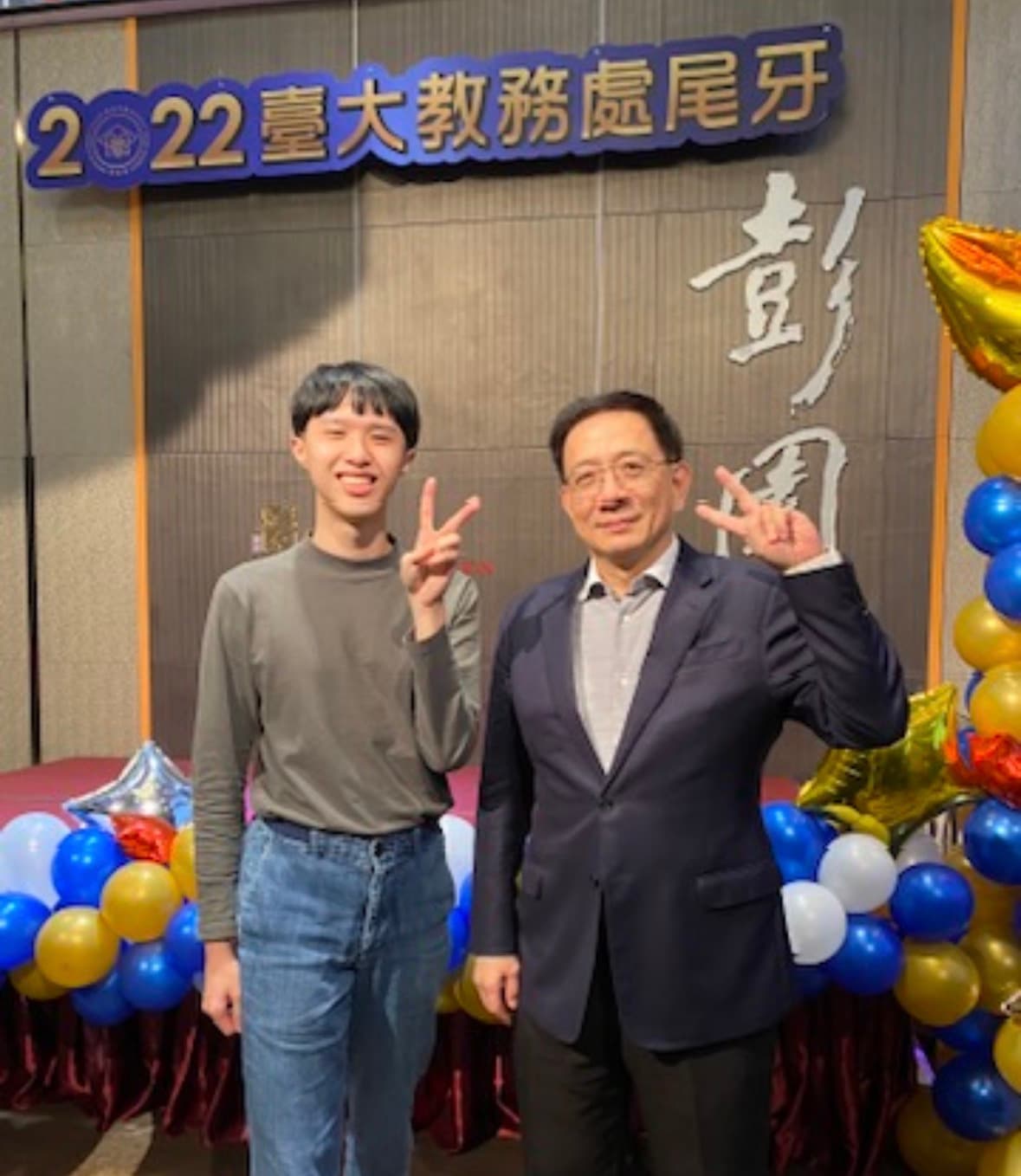
During ND there was one project that shaped me deeply, and it may well be the single largest factor that pushed me toward Service Design at the RCA — my junior year, together with two partners from the ND community, partnering with the engineering team at Course Neo (which was the prototype of the system), we worked on the course selection system for NTU's Office of Academic Affairs.
This was the first time I truly experienced how challenging "driving system design inside the public sector" is. That was 2022 — pre-AI, an era when "digital transformation" was still the phrase.
I first grasped the full weight of the word stakeholder.
Once workflow and accountability double down and compound with the relationship, the stakeholders then expands from just surface users down to the administration and the technical layer underneath. Every layer has its own logic, its own considerations, and no layer can be skipped. The layer, along with different groups of people, collides and negotiate a way out for compromises.
We did school-wide user research process and a series of UX proposals, but when the time came to actually ship — factoring with technical structure, future maintainability, and much else — what we eventually change was only a fraction of what we had planned.
That story is long — I'll go into the full context in another piece. But my biggest lesson was: always leverage the organisation first.
To design systems, or designing at a system level (by which a system can be further broken down into software, organisation, and various layers of service blueprint); often, before even stepping into the design task itself, finding the right spot in the loop to interject is the day 1 work.
During this project I had witnessed how change could and should happen in public sector, I wanted to know how large-scale, public-facing design would be brought into practice.
Social Design and Human-Computer Interaction
I started taking courses at D-School from sophomore year onwards, five in total and three of them shaped me deeply.
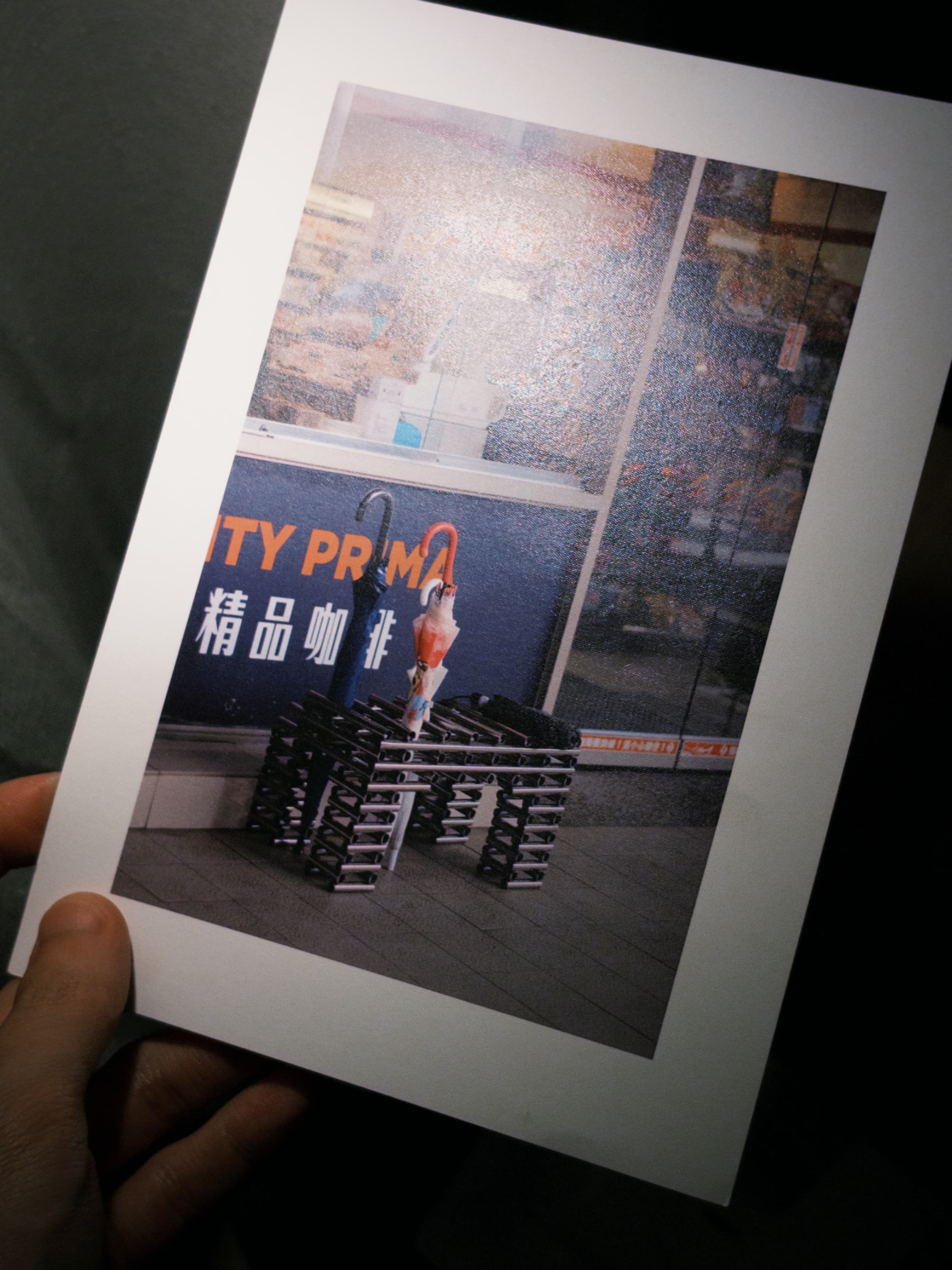
The first two were about social design — a series of courses on "objects" run by Professor Hsu-Wei Huang, whose background was in sociology. The course was not to teach us to sketch or run journey maps, he started with a set of objects like beer, bikes and umbrella stands etc to prompt us into thinking the ideology behind them.
One of those courses was cross-listed with the Industrial Design Institute at Shih Chien University, co-lectured with Professor Lu-Lin Cheng, colliding sociological framing and industrial design training in the same room. That course was my initiation into what I would later call "object entanglement" — behind any product, there is far more than its surface intention; there are layers of why:
- "Hey, I want to make this product, this way"
- "Why am I making this product"
- "Why do I think about making this product the way I do"
- "What social structures does this thinking inherit"
Design has never only been about form — it is the way how society sees the world, fossilised into something you can hold.
The two classes also surfaced something a bit abstract for me: Taiwan does not have "design" in the proper, our-own sense. What we lack is not talented designers — Taiwanese designers hold their own against anywhere — what we lack is our own theoretical tradition and inheritance of practice.
What we have inherited is Japanese refinement, European minimalism; the vocabulary and aesthetic are all borrowed. We have execution; we don't have discourse. This is, of course, bound up with our postcolonial history — a thread I have long been drawn to, but unpacking it is another piece in its own right. (This became far more concrete for me later, even after London, in reflexive hindsight.)
Beyond sociology, the HCI course at D School and my time on the OpenHCI conference, had also shaped my view on industrial design and psychology.
Before that, my exposure to "design" had mostly stayed at the level of software and interface — pages, buttons, flow diagrams. But the HCI stimulations pushed me into the hardware universe. I began sitting with mechanical engineers and industrial designers, watching how they reasoned from a printed circuit board, from the radius of a corner on an enclosure, from the order of a wire harness, all the way to what the product ought to be.
HCI at that moment was very into the idea of human-machine interaction — especially robotic arms and quadruped robots — and I even joined a few Open Lab visits at NTU's Department of Electrical Engineering. It was the first time I felt the object-ness of design — how a product gets manufactured, how it lands in the real world, how it is touched and used.
The two threads together rounded out how I see "design", and gave me an even more polarised idea of design: social design told me that design carries worldview and macro-structure; HCI told me about design's physical and mechanical dimension, and about interaction at the micro-scale.
With the two input, still I felt something was missing — a mode of discourse that could pull the whole picture together.
The Y.L. Lin Scholarship and Service Design
In senior year I applied for the Y.L. Lin Scholarship.
Y.L. Lin is one of the few Taiwanese scholarships that looks past your transcript at your vision for society. The programme runs across an entire academic year, much like a massive reality show, with over a hundred applicants competing for roughly a dozen spots. My theme was "bringing design to the public" — making design as a way of seeing and understanding problems.
That application was a turning point. To write it, I had to take four years' worth of scattered experiences — ND, my projects, D-School courses, the freelance work — and string them into a single narrative. I think it was the first time I realised how I've been trying to pull things together and to that point it worked.
DreamVok and 5% Design Action
Also during senior year, I joined DreamVok as an intern.
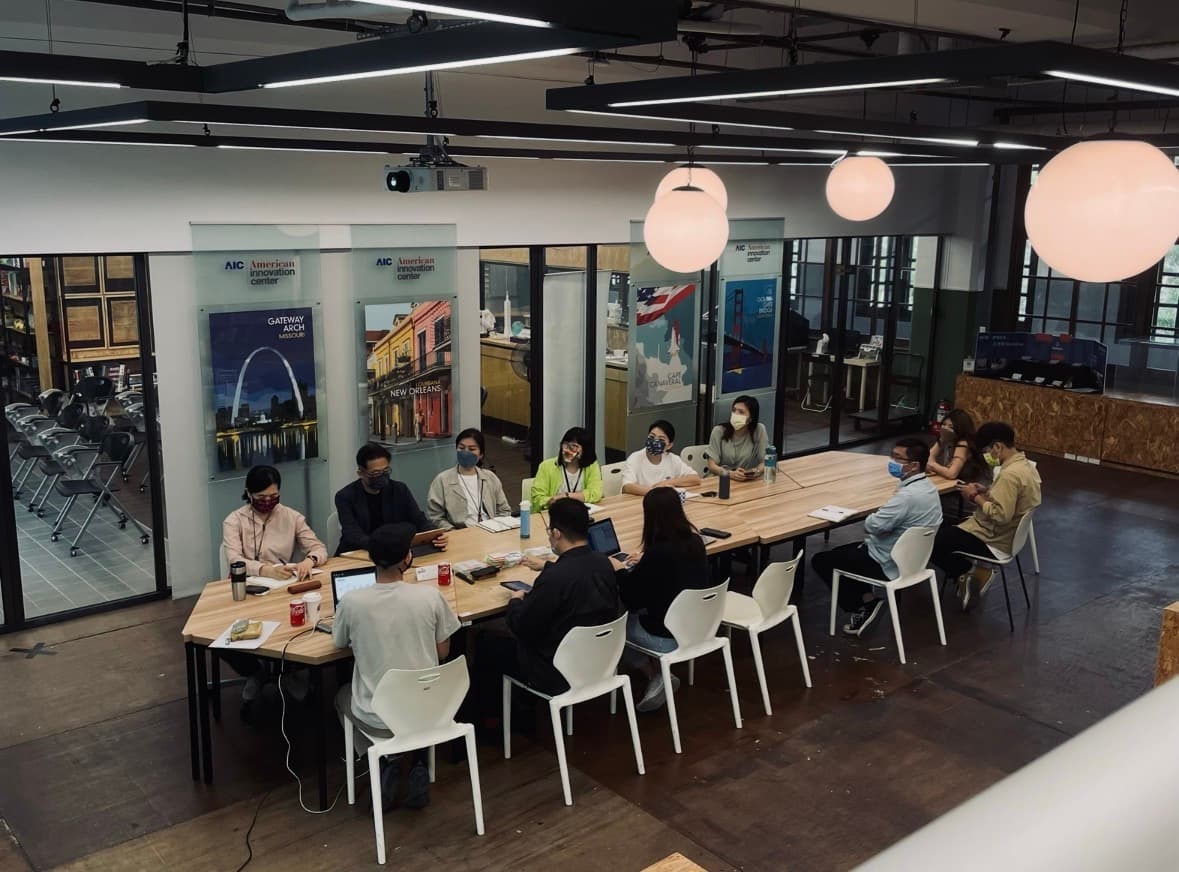
DreamVok's CEO, Kevin Yang, is also the founder of 5% Design Action — a non-profit rallying designers to contribute 5% of their working hours to social issues. Over those months I worked alongside my supervisor Yu-Hao on a sustainable transformation project for Songshan Cultural and Creative Park — analysing cases, co-facilitating workshops, and consolidating everything into a proposal. The Songshan team accepted it, but as an organisation operating under BOT terms, the room for actual implementation was limited.
That internship also showed me something: at the intersection of business and design, there is a small strip of ground with very few people standing on it — design consultancy. Taiwan's design consultancy market is small, only a few people manage to pull out some gig on this; most people from a business background don't understand design method, and most from a design background aren't fluent in what the market actually needs as a solution.
At DreamVok I caught a glimpse of how design is creating impact — but simply a glimpse as what an internship is always limited. The moment during that internship that actually changed me was not the project itself — it was the person I met during the annual team dinner.
That evening I found myself sitting next to a person, her name is Jess.
She was an alumni of RCA IDE programme, and had worked in several design consultancies in the UK for ten years. I was in the middle of preparing my RCA application — I had scraped the website raw, I had scrolled through their Instagram to nothing, but first-hand material on the master's was hard to find as design graduates are all not big writers.
Over that meal Jess told me what her years at RCA had been like, what London's design scene looked like, what those consultancies were actually working on day to day, what kinds of briefs, what kinds of clients. It was the first time someone narrating "I lived there" to me, rather than in the voice of an admissions brochure.
(Before I went to RCA, I'm very blessed for the opportunity to join Jess at Revere. Jess is the most well-rounded boss I have ever had.)
Looking back, bumpy is the only word I'll use to quote.
Even till now, summertime in 2026 after things been wrapped up for a while. I still feel I am still in the process, on finding what my beliefs and world view should look like. But looking back at the journey, I somehow find myself thinking, huh, quite a long time has passed.
Everything is vividly there in front of me, yet also feels distant.
Like looking through a layer of gauze — a little familiar, a little foreign.
The story of how I actually prepared my RCA application, and what my year in London was like, I have written up in separate pieces.