View Slides (PDF) · View Slides (HTML)
Overview
- Generated and translated industry insights over 50 best practices analysis into business strategy and actions
- Facilitated co-creation workshops and developed tools to iterate service prototypes
- Proposal was accepted and incorporated into SCCP's annual business plan
- Further partnered with SCCP to hold RA100, a forum gathering over 100 renowned businesses and figures
Time ~6 months
Role Service Designer
Background
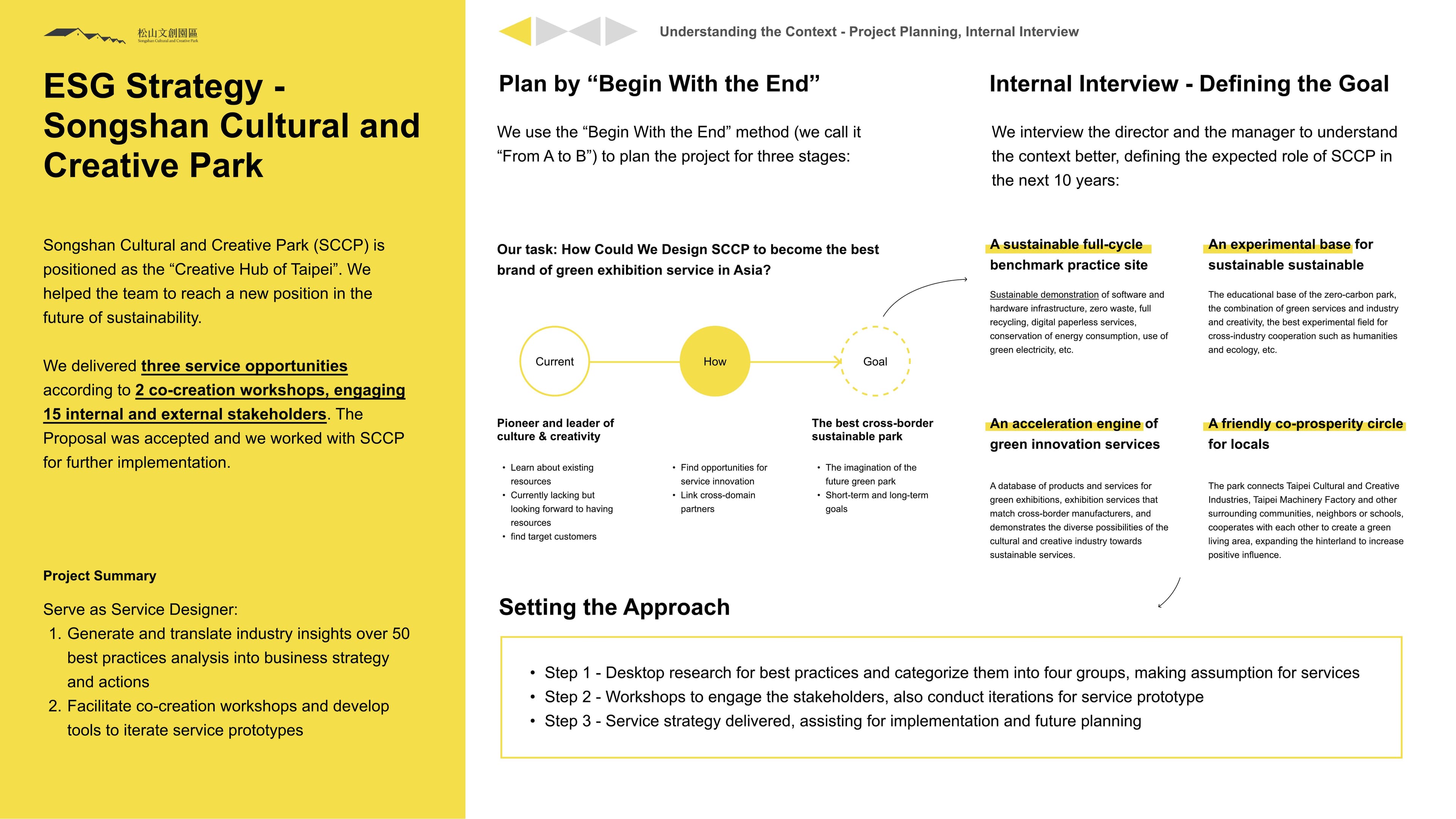
Songshan Cultural and Creative Park (SCCP) is positioned as the "Creative Hub of Taipei". We helped the team reach a new position in the future of sustainability.
We delivered three service opportunities according to 2 co-creation workshops, engaging 15 internal and external stakeholders. The proposal was accepted and we worked with SCCP for further implementation.
Our task: How could we design SCCP to become the best brand of green exhibition service in Asia?
Plan by "Begin With the End"
We used the "Begin With the End" method (we call it "From A to B") to plan the project for three stages:
- Current — Pioneer and leader of culture & creativity. Learn about existing resources. Currently lacking but looking forward to having resources. Find target customers.
- How — Find opportunities for service innovation. Link cross-domain partners.
- Goal — The imagination of the future green park. Short-term and long-term goals.
Internal Interview — Defining the Goal
We interviewed the director and the manager to understand the context better, defining the expected role of SCCP in the next 10 years across four pillars:
- A sustainable full-cycle benchmark practice site — Sustainable demonstration of software and hardware infrastructure, zero waste, full recycling, digital paperless services, conservation of energy consumption, use of green electricity, etc.
- The best cross-border sustainable park — The educational base of the zero-carbon park, the combination of green services and industry and creativity, the best experimental field for cross-industry cooperation such as humanities and ecology, etc.
- An acceleration engine of green innovation services — A database of products and services for green exhibitions, exhibition services that match cross-border manufacturers, and demonstrates the diverse possibilities of the cultural and creative industry towards sustainable services.
- A friendly co-prosperity circle for locals — The park connects Taipei Cultural and Creative Industries, Taipei Machinery Factory and other surrounding communities, cooperating with each other to create a green living area, expanding the hinterland to increase positive influence.
Approach
Desktop Research — 50+ Best Practices
We analysed over 50 cases worldwide, categorising them into four strategic directions:
- Eco-friendly Material — Redesigning the exhibition process to create mutual benefits with customers
- Repetitive Cycle — Reducing single-use items, extending the lifecycle of hardware, products, or services
- Digital Empowerment — Using technology to enhance awareness, assist behaviour change, and create new communication interfaces
- Partnership & Alliance — Finding suppliers and partners in the industry, connecting with diversification
Workshops — Building Toolkit for Co-creation
We conducted two workshops:
- Internal workshop — Building cohesion within the SCCP team, inventorying resources, and using persona tools to form three main target audiences
- External workshop — Inviting stakeholders for partnership establishment and innovative service discussion, developing roadmap and planning tools to break down professional concepts
Delivery
We finalised three service opportunities and actions based on SCCP team's feedback, considering feasibility:
Opportunity 1: Create Positive Influence via Sustainable Curator Incubation
- Action 1 — Powering up Current Service: Start implementing the "sustainable consultant" service into each interaction with client, push them to use green/current techniques, thus transforming the following exhibition into a demo of sustainable best practice. Plan for sustainable exhibition services including digital curation services, exhibition carbon footprint verification, exhibition rack rental, post-exhibition materials remanufacturing & sales flea market. Compile the sustainable partner database or produce white papers about green exhibition service experience.
- Action 2 — Becoming Sustainable Exhibition R&D Centre: Organise an R&D team (self-run or cooperate with partners), designing exclusive training courses/workshops and training sustainable lecturers, which strengthen SCCP's brand volume & recognition. Connect international organisations, enhancing SCCP's professionalism through cross-border partnerships.
Opportunity 2: Provide Cycle of Solutions with Green Service Plan
- Action 1 — Generating B2B Service: Combine with existing products or services, developing a SCCP promotion campaign. Set up an incentive mechanism, such as rental discounts, vendor recommendation mechanism, or green points to encourage duration discounts, etc. Create a "Certificate of Sustainable Effectiveness" as partner certification.
- Action 2 — Designing 2C Daily ESG Experience: Hold regular brand exhibitions at SCCP to showcase various aspects of sustainability. Share the general public the possible appearance of sustainability in life through activities like "meatless markets", "zero waste experience", or by setting up environmentally friendly creature stations in existing weekend markets. Connect neighbourhood, such as Eslite Travel and surrounding neighbourhood or stores, creating a rich and close experiential journey and out SCCP. Let the tourists not only watch exhibitions, but also experience sustainability in the surrounding shops.
- Action 3 — Creating a "Sustainable Demo Lab": Gather green solutions and present them in a fixed exhibition space in the park, such as recycled packaging, display panel remanufacturing, digital integration services, etc., to present the most edgy benchmark cases of sustainable exhibitions.
Opportunity 3: Build Innovative and Resilient Park with Digitalization
- Action 1 — Integrating ESG Resources: Apply SCCP's experience in curation and training to assist partners in transformation. Pair up resources, create cooperation service or jointly launch sustainable products or green exhibition services to add brand value. Promote the revision of relevant regulations, becoming a certification authority for green exhibition services.
- Action 2 — Digital Transformation: Construct digital infrastructure, such as data collection and analysis of visitor's flow. Implement digital service system from SaaS partners, such as visualizing the carbon emission of the product or services consumed in the park. Provide an experimental environment for forward-looking sustainable solutions, utilising the park's system to provide testing services.
- Action 3 — Sustainable Neighbourhood & Network: Connect with surrounding neighbours and residents, build collaboration service to support park services. Establish "Green Sustainable Ambassador" — connecting teachers, students, or clubs, etc., give promotion tasks to students of certification/teaching points and other programs.
Partnership Mapping
We also mapped out the current and potential network, briefly categorising them for SCCP team to develop future services. Partners span across categories including cross-border exhibition groups, sustainable high-end product/service providers, technology integration, and service design — connecting organisations such as 5% Design Action, RAW, Eslite, CityGreen, and multiple university programmes.
Outcome
We proposed the finalised strategy to SCCP's administrative team. The director adopted and incorporated the service plan into the following annual business plan.
We further partnered with SCCP to hold RA100, a forum about ESG's future in Taiwan, which gathered over 100 renowned businesses and figures including the president and councillors.
Learning
The project is related to business and the ESG trend. I tried to solve the problem through service design methods, which made me understand the power of design thinking in integrating multiple fields. This is my first "Service Design Project", yet it has already pushed me forward to seek more advanced and complex issues to break down.