View Slides (PDF) · View Slides (HTML)
Overview
- Served as Product & Project Manager
- Guided a team of UI designers and full-stack engineers through research, insight extraction, and product feature planning
- Managed the 4-month agile development and chaired weekly development meetings
- Product reached a peak of 5,548 daily page views and an average usage of 167 within three months
Time ~4 months
Team Product Manager, UI Designers, Full-stack Engineers
Background
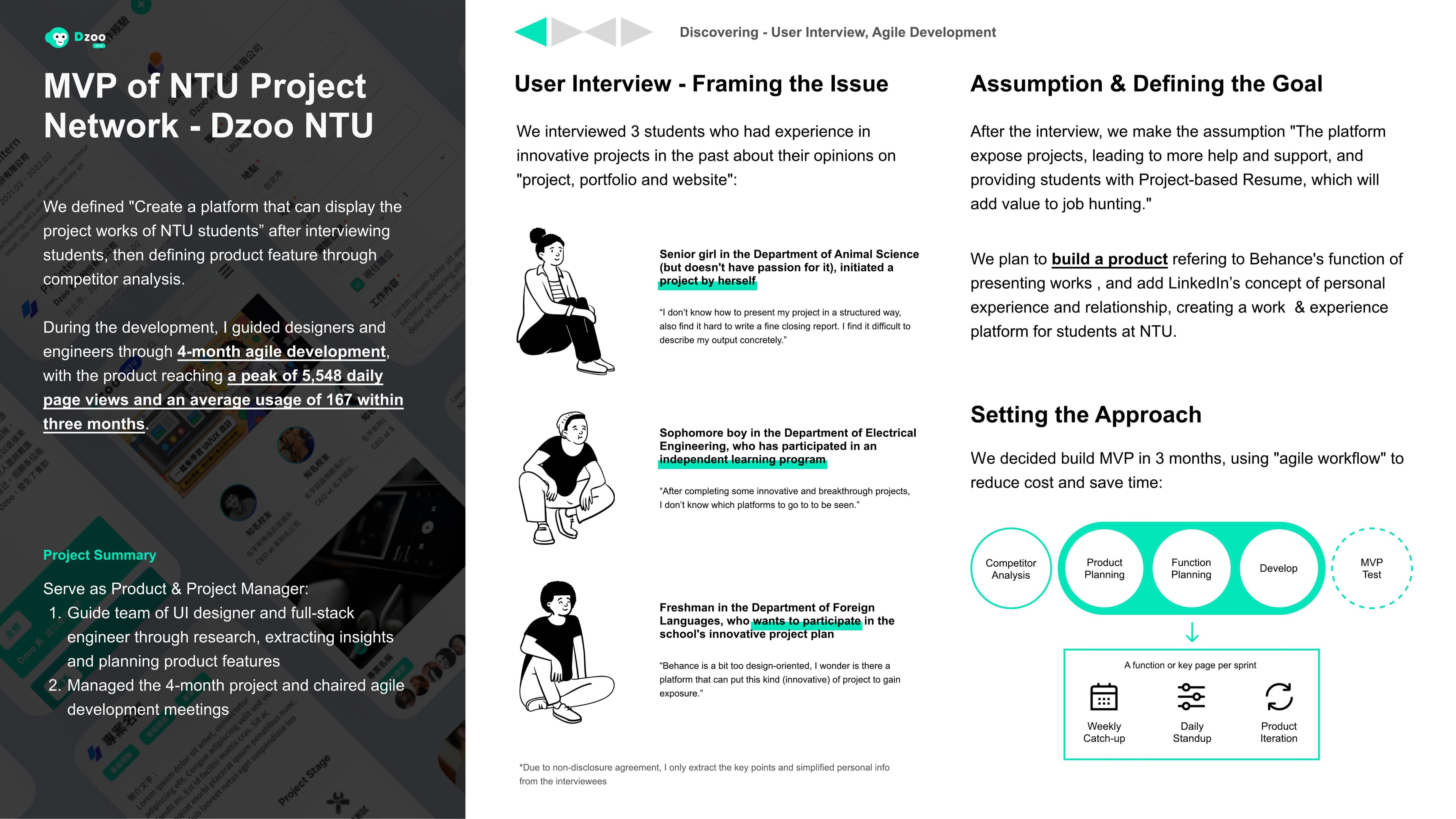
We defined "Create a platform that can display the project works of NTU students" after interviewing students, then defining product features through competitor analysis.
User Interview — Framing the Issue
We interviewed 3 students with experience in innovative projects about their opinions on "project, portfolio and website":
- A senior student who initiated a project by herself but didn't know how to present it in a structured way
- A sophomore in Electrical Engineering who had participated in an interdisciplinary programme but didn't know which platform to use for showcasing
- A freshman in Foreign Languages who wanted to participate in innovative projects but didn't know where to start
Assumption & Defining the Goal
After the interviews, we made the assumption "The platform expose projects, leading to more help and support, and providing students with Project-based Resume, which will add value to job hunting." We plan to build a product referring to Behance's function of presenting works, and add LinkedIn's concept of personal experience and relationship — creating a work & experience platform for students at NTU.
Positioning Dzoo
We gathered insights from interviews and built a quadrant diagram by "Display Orientation" and "Purpose of Use":
- Dribbble — Social-oriented, visual-oriented. Self-promotion and social networking for designers and creatives.
- Behance — More work-oriented than Dribbble. Designers tend to use as "portfolio" or an official showcase of work. Could submit media and docs, but only for supplements. "Multi-owner" provides more exposure per project.
- LinkedIn — Business and employment-oriented. Updates and posts from networks.
We positioned Dzoo as a 70% information and 30% visual project platform, designed for contextual project showcase. Key differentiators: five project stages (from Ideation to Execution), "Team" to add value and recognition, "Follows & Views" to reinforce the loop, "Market" for freelancer needs, "Hire" without being charged, and "Connect" representing real-world business manner.
Approach
We decided to build the MVP in 3 months using an agile workflow: Competitor Analysis → Product Planning → Function Planning → Develop → MVP Test, with a function or key page per sprint, supported by weekly catch-ups, daily standups, and product iterations.
Product Build
A platform for displaying projects and innovative ideas. To encourage concepts at different stages, Dzoo provides five project stages from Ideation to Execution. Users can classify their status, and we expected that projects alike would spark between like-minded partners.
Key features:
- Index & Project Showcase — A platform for displaying projects and innovative ideas. To encourage concepts at different stages, Dzoo provides five project stages from Ideation to Execution. Users can classify their status, and we expected that projects alike would spark between like-minded partners. Browse and click any project at the index page.
- Personal Profile for Network & Professional Use — Users can add internship, work experience, and self-introduction to create a personal profile. The personal profile is linked to the user's projects, so it could also be used as a portfolio for future job hunting or advanced study.
- Dashboard for Intuitive Management — Users could easily manage and adjust their project with the intuitive dashboard. One can also send invitations to team members to co-own the project, further empowering the value of a project team.
Outcome
After releasing the MVP, we reached a peak of 5,548 daily pageviews and maintained an average product usage of 167 within three months.
We began working with school authority for implementation, connecting student teams at NTU d.school, the Academic Affairs Office, and the Student Affairs Office for further integration.
Learning
Dzoo is not only an initiator at school — it also served as my stepping stone into digital solutions. Driven by the innovative force at NTU, we continued product iteration to meet expected user experience, forming an even more complete structure.