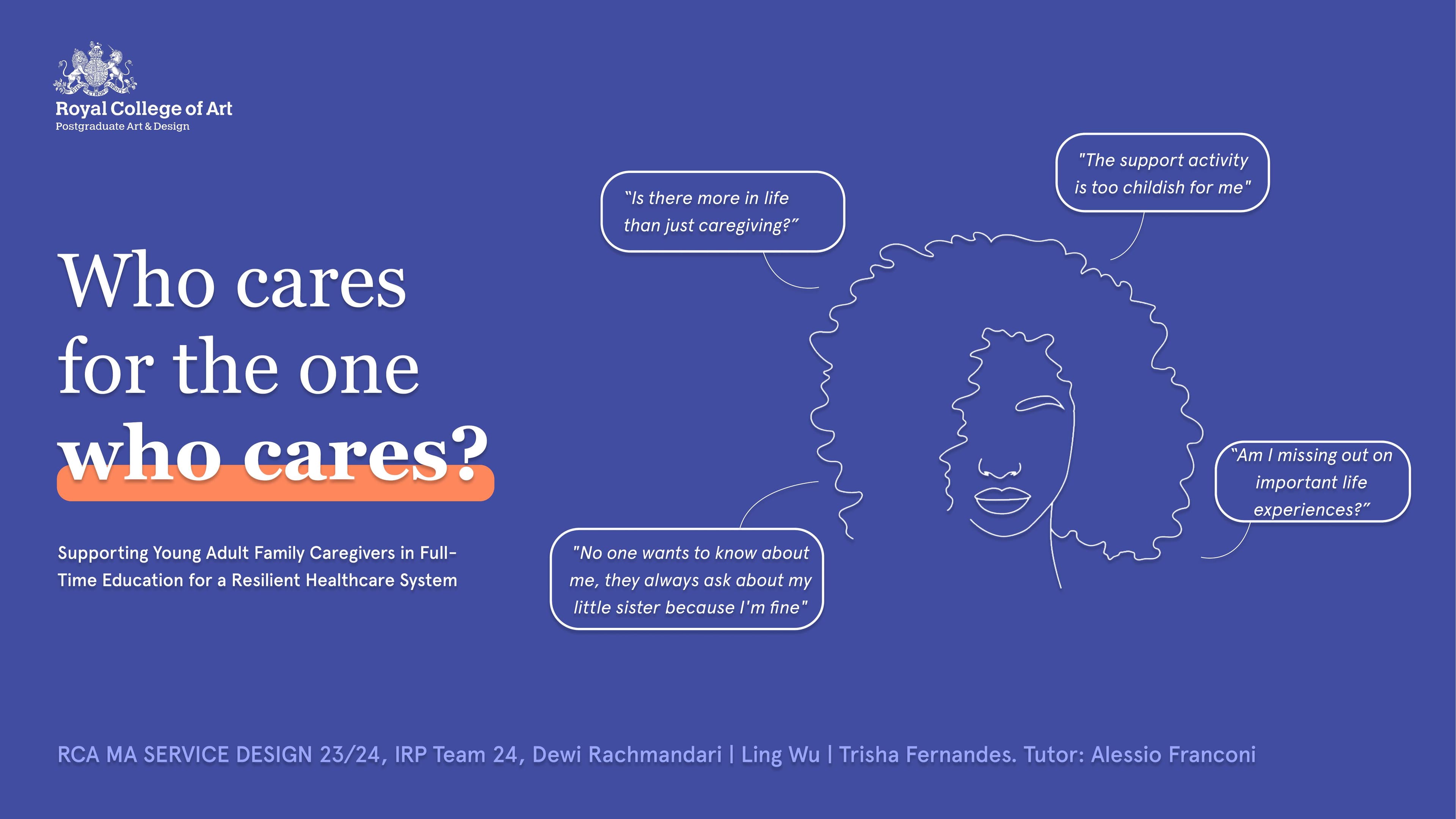
View Slides (PDF) · View Slides (HTML)
Overview
- Led primary research including 12 young adult caregiver interviews, 5 NHS worker interviews, and 5 carer organisation manager interviews
- Co-designed service concept through 3 rounds of ideation and validation with carers and organisations
Time March – July 2024
Team Dewi Rachmandari, Ling Wu, Trisha Fernandes
Tutor Alessio Franconi
Programme RCA MA Service Design, IRP (Independent Research Project)
Background: The Seen and Unseen
"The simple act of caring is heroic." — Edward Albert
In the UK, the economic value of unpaid carers reaches £162 billion per year — exceeding the NHS budget of £153 billion. There are 600,000 young adult carers aged 18–25, spending an average of 35 hours per week caring. There's a 50/50 chance any of us will become a carer by our 50s.
What's visible on the surface — an overburdened NHS, scarce social care, insufficient funding, and a patient-centric healthcare system — obscures a deeper set of structural issues:
- Cultural "expectations" of caregiving that go unquestioned
- Young adult carers can't get carer's allowance if they study over 21 hours/week
- Young adult carers are 3 times as likely to be NEET (not in education, employment, or training)
- The grey area between healthcare and social care — not fallen under NHS nor council
- Family carers providing essential support to their loved ones with little recognition
Meet the Superhero in the System
Kay Jeannette (21) — A young adult caregiver and full-time law university student living with her parents and younger brother. She has to care for her mother, who is ill with a long-ill chronic disease, while her father, the primary earner, is busy with work.
Pains: Dual Life, Time Poor, Isolated
Needs: Support, Respite, Balance
"People accusing me of using caring as an excuse for not showing up so many times."
Research: The Geographically Tied yet Off Radar 20s
Through in-depth interviews with 12 young adult caregivers, 5 NHS workers, and 5 carer organisation managers, alongside desk research, hospital observations, and a young adult carer forum, six key findings emerged:
- Boundaries for carers are needed to maintain a sense of identity and personal fulfilment
- Routinising life simplifies management of tasks but eventually it chains carers in a loop and prevents them from finding respite breaks
- There is a gap with existing support — young adult carers are not engaging with the support; only young children and older carers are engaged with the organisations
- Life planning will always revolve around the care recipient — the caregiver is not only geographically tied but mentally tied
- The shift in roles and responsibilities can strain family bonds, making "caring" a structured responsibility rather than a natural act
- "Guilt" is present in both parties, patient and the carer — one is dependency and the other is time, effort. Society's expectations and personal judgements make carers hesitate to utilise full support available
Reframing the Problem
The current state: carer and care recipient are overly involved, leading to loss of identity of the individual and a sense of guilt. Our goal: create space between them through a service that draws boundaries in a guilt-free environment by utilising available support systems and networks — giving carers space to grow as an individual and a carer, time to connect and time to detach, and space to connect with existing support.
How might we establish physical and mental boundaries between a carer and the care recipient to help the carer develop a distinct sense of identity and ease the feelings of guilt?
The Ideation Journey
We went through 3 rounds of ideation and validation with carers and carer organisations:
-
CareConnect — Connecting Young Adult Carers
- What we learned: Carers, like everyone else, often want to engage with non-carers and communities outside their caring responsibilities. Would it be impactful to connect to other carers?
-
Grassroots approach of Carers + Local Council Toolkit
- What we learned: This service is idealistic and not feasible, requiring significant changes in local councils. Adding new support won't help if they don't want to engage in the first place. There are already many existing supports, but they feel like another chorus to do.
-
Carerou
- What if their need is actually to create boundaries, where they can connect and detach from their caregiving responsibilities? What if we use the time where they are not at home and on university for the intervention?
Our Service: Carerou
Carerou transforms carers' daily journeys into moments of respite.
- Route Guide — Mindful walking routes that transform daily commutes into restorative experiences, with physical cues and hidden neighbourhood gems. Changing their daily commute as a mindful walking experience and respite time for themselves — a behaviour change intervention.
- Co-creation — Encouraging carers to contribute thoughts and reflections during walks, building a community-sourced map of meaningful spots
- Care Corner — Physical touchpoints in local cafes and spaces, enabling indirect community support and conversations over coffee. Helping carers feel supported and valued by seamlessly integrating community assistance into their lives.
- Community Engagement — Encouraging carers to develop their identity beyond their caregiving role, enhancing engagement with existing support systems
Driven by Engaged Carers, Owned by Community
The sustainability model centres on former carers running and owning Carerou. They gain personal fulfilment by giving back. The service partners with local businesses to extend service reach, connects to carer charities for funding and engagement, receives funding from local councils, and engages new residents and busy youth alongside current carers — creating a flywheel where a few current carers might become former carers who then run the service.
Validation with Stakeholders
Testing conducted across three periods (3 days, 5 days, and 1 week):
- Mindful Route — All participants expressed a desire to repeat the experience, finding it a mindful break from busy routines. Participants noticed different things and had unique approaches to mindful walking.
- Carer Corner — Tested at Starbucks Fulham Broadway & RCA Cafe. Local spaces were receptive to hosting care corners, which fostered conversations and increased footfall.
- Idea Pilot during Exhibition — Tested the app prototype by providing route suggestions for visitors travelling from Battersea to the nearest tube station. Visitor feedback was positive; they found the service interesting and surprising — not the first solution they would have thought of.
- Service Validation with Carer and Carer Organisations — All users loved the idea.
Theory of Change
The Hypothesis: If daily transition times are utilised for interventions → then carers will develop habits of taking regular respites and finding beauty in ordinary things → then this practice will help prevent burnout, provide time for personal development, and increase carers' capacity to offer compassionate care → consequently, carers will feel more connected to their communities and achieve a better balance in their caregiving responsibilities → as a result, this approach leads to sustainable quality caregiving, personal well-being, and empowers carers as vital members of the healthcare system.
Impact cascade: Carerou → Self → Space → Neighbourhood → Community → System
- Self — Habit of taking regular respites, the act of noticing beauty in ordinary things, first step to step out of the house
- Space — Burnout prevention, time to develop interests, balance caregiving with personal growth
- Neighbourhood — Creating mental boundaries through familiarising with local spaces
- Community — Familiarity with the neighbourhood, awareness about carers in the community
- System — Stronger connection with community support systems, less care leavers, better continuity of care
Vision
| Short Term (1–2 yrs) | Mid Term (2–5 yrs) | Long Term (5–8 yrs) | |
|---|---|---|---|
| Service | Establish collaborations and user base | Enhance route experience with spaces and physical cues | Carer club — a space for 'me' as well as 'we' |
| Impact | Increased motivations | Increased familiarity and awareness | Balanced carer life |
| Measurement | Daily/monthly usage, active users, sign-up rate | Physical drop-in rate, online-to-offline conversion | User retention, carer assessment, turnover rate |
The Constraints
- Motivations for staying engaged — Habit building / behaviour change has unpredictability. Once carers know their neighbourhood and start taking small respites everyday, digital touchpoint use frequency might drop.
- Cultural, spaces & service relevance — This service is currently suitable in walking cities like London.
- Measure impact beyond user data — Current measurement tools could only track carer engagement in short term but not the actual long term personal impact.
Learning
- Consider the level of design interjection — Strong and weak interjection brings out different outcomes targeting similar goals. For healthcare services, strong interjection could bring impact efficiently but create irreversible side effects and having ethical issues.
- The system has seen and unseen players — Being observant can help identify hidden roles played in a surrounding. Empathy can guide to uncover their stories. Like the struggle accepting the title of 'carer' when it's an act towards a loved one. Culture is a huge influential factor in shaping the system.
- Balancing bias — Choosing a project based on personal experience introduces bias, offering deep understanding and empathy but potentially overshadowing objective analysis and alternative approaches. Balancing personal insight with self-reflection and diverse feedback is crucial.