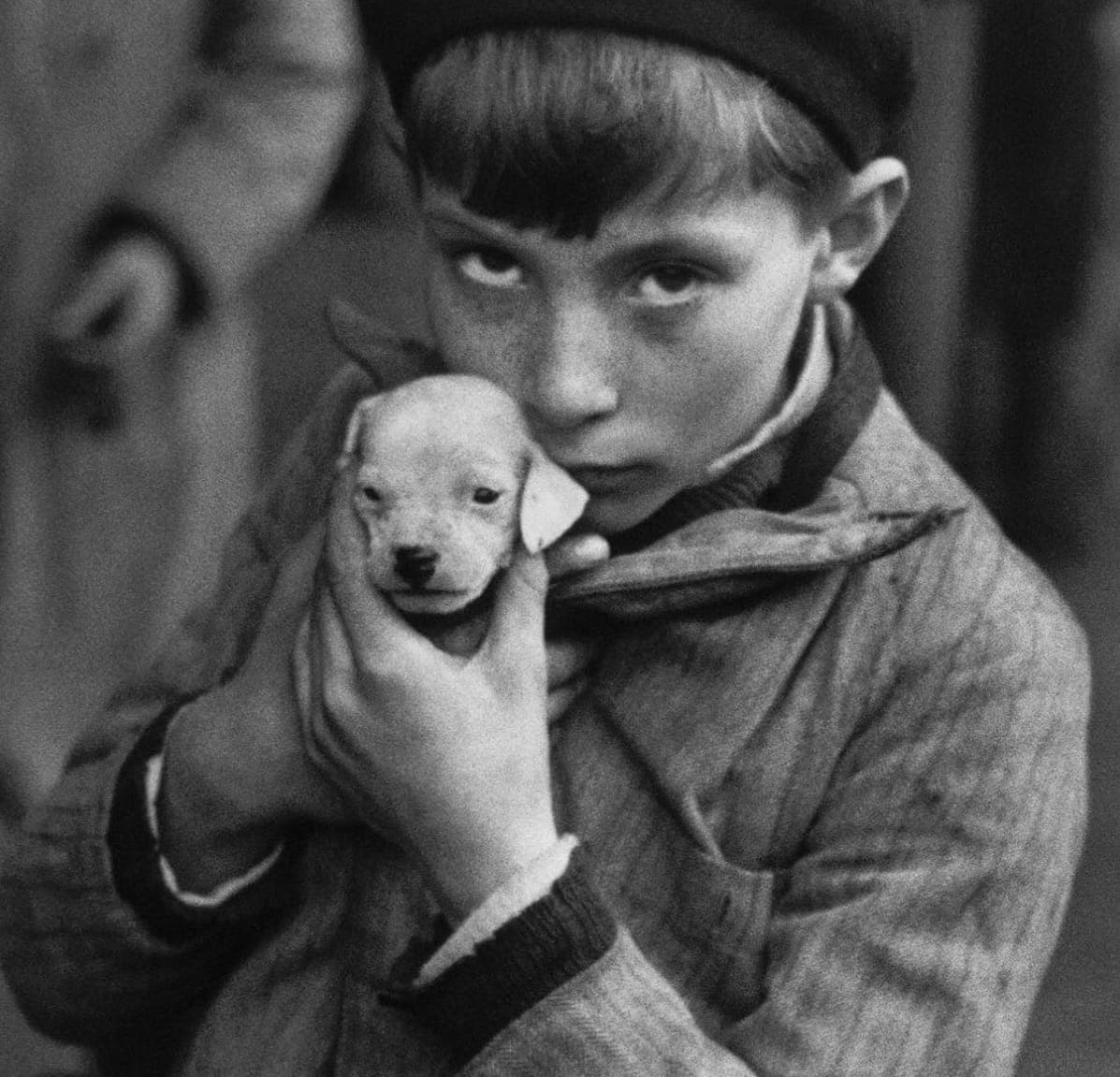
My year in London gave me a habit of visiting photography exhibitions. I've never read or studied any photographic theory, and I have no understanding of photography as a technique or tool. Even so, when looking at the work of contemporary photographers especially, there are always one or two moments where a thought surfaces: "Ah, what a layered photograph."
It wasn't until I picked up Roland Barthes' Camera Lucida: Reflections on Photography that I understood: photography carries "codes." These codes record the Studium contained in the moment the shutter is pressed, and through the Punctum -- produced by each person's unique life experience -- we are touched.
The Philosophical Implications of Photography Through Studium and Punctum
Here I draw on Kangkang's summary of Camera Lucida and Linghuai's notes, with my own interpretation added:
- Studium: From Latin, originally meaning "zeal, study, effort, pursuit." A shared, ordinary affect -- the viewer's general interest or aesthetic response to a photograph. It is relatively rational, can be taught and shared, but is not particularly intense (here, "intense" refers to the collision between the reflections provoked by viewing a work and one's personal cognition). Similar to a work's description or guided reading, it tends to be universal.
- Punctum: From Latin, originally meaning "point, sting, puncture." An individual's intense resonance with a work -- some detail in a photograph that powerfully and personally strikes the viewer, like being pierced, carrying an emotional impact. Similar to how a past event -- a previous trauma, a deep memory -- when triggered, produces an indescribable state.
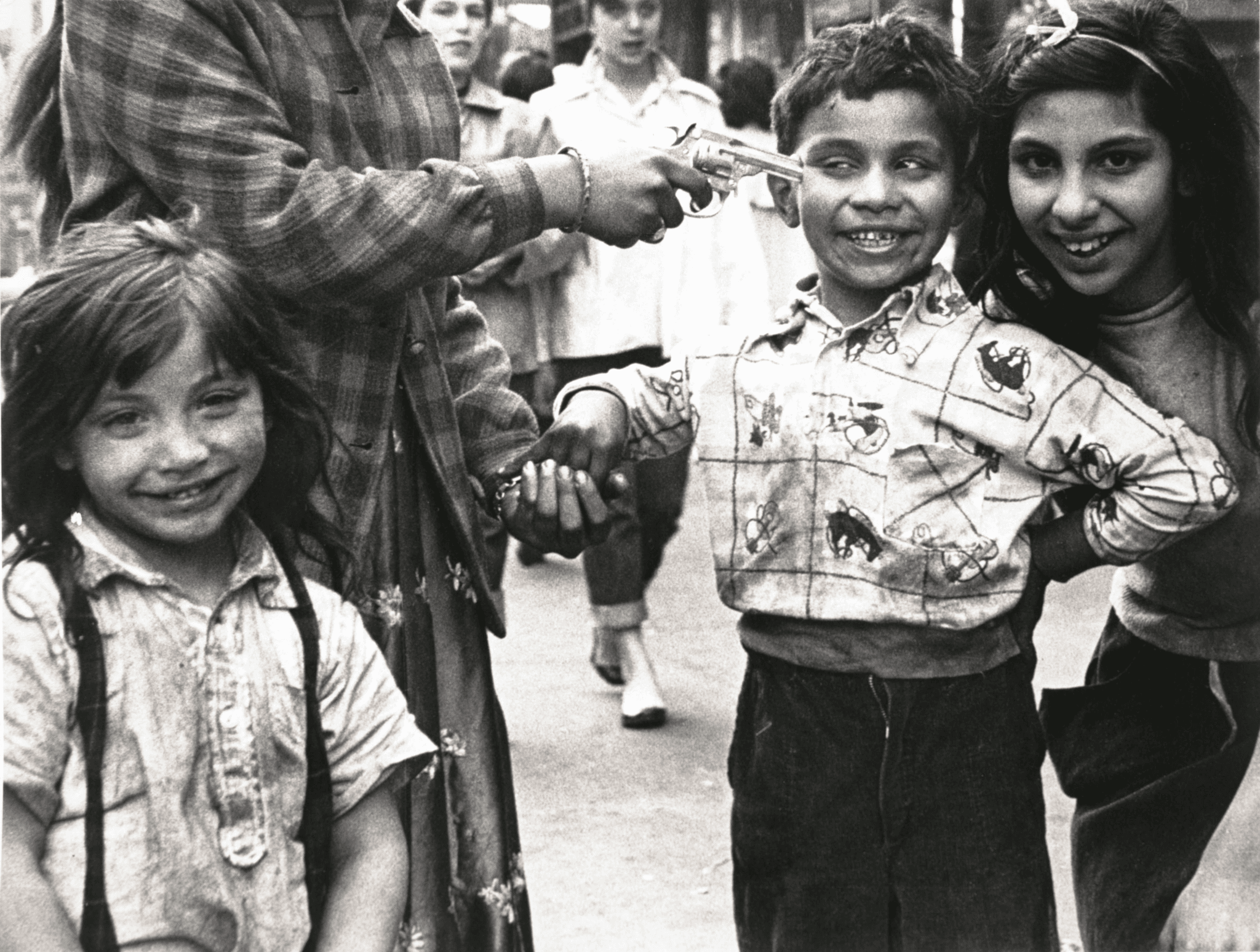
"But what I kept staring at was the boy's bad teeth," Barthes said. This reflects the universality of Studium, and how individuals, due to differences in life experience, are struck by different Punctums.
Before Barthes imbued "Studium" and "Punctum" with philosophical meaning, the two words carried no particular significance. Barthes himself was not a photographer; he had no connection to the photography world whatsoever. He simply collected his rambling commentary, blended it with his research in semiotics, and bound it into a volume titled Camera Lucida.
Camera Lucida vs. Camera Obscura: Revealing the Essence of Photography
The Chinese title Ming Shi (literally "Bright Room") -- the original French is La Chambre claire, translated to English as Camera Lucida -- contains within its very name a response to and reflection on the photographic tradition of the "darkroom" (Camera Obscura). Camera Lucida in Latin means "bright room," while Camera Obscura means "dark room" -- the latter being the optical device commonly used in early photography and painting, and the etymological source of the modern darkroom.
As a semiotics heavyweight, Barthes was no stranger to naming -- and Camera Lucida naturally carries multiple layers of symbolic meaning:
- The contrast of light and dark: The darkroom is the traditional space for developing photographs, full of mystery and invisible processes. The bright room symbolizes seeing, revealing, and disclosure, emphasizing photography as a medium that "makes reality visible."
- The subjectivity of viewing: Focusing on how the Spectator confronts photographs directly in the "bright room" -- confronts death and memory -- rather than performing technical operations in a darkroom.
- A theoretical shift: No longer merely discussing photography's technique or semiotics, but entering a "bright" space where emotion, memory, and existence can be illuminated and discussed.
This title is not only a tribute to the history of photography and a reflection on its tools, but also symbolizes his wish to "illuminate" the essence of photography for the reader (the word "enlighten" comes to mind -- carrying both the meanings of illumination and intellectual awakening), thereby transcending the purely technical plane and entering the realms of philosophy and existence.
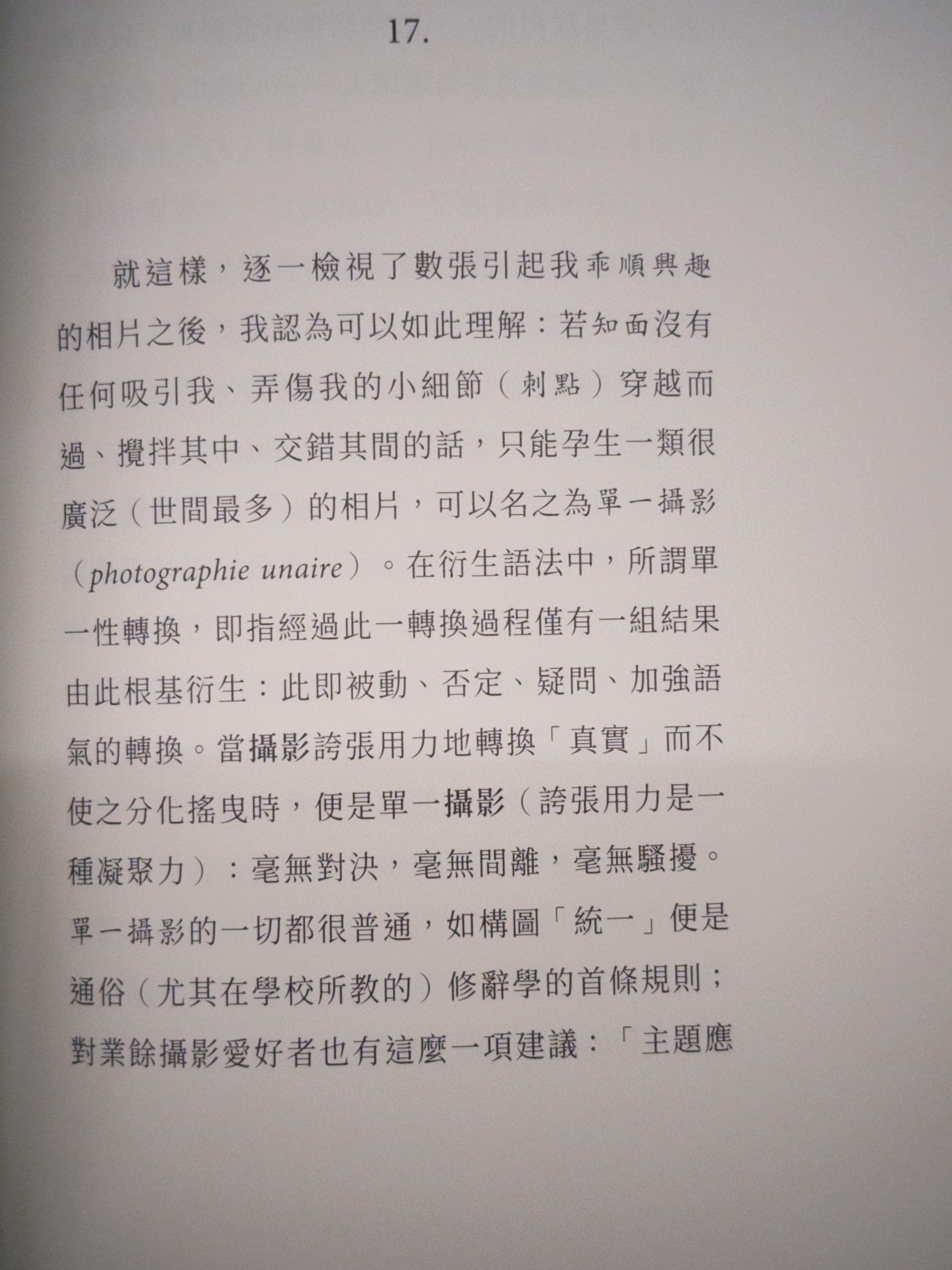
Photography exhibitions are a refined yet difficult-to-grasp form of contemporary art. They contain implicit resistance against the tool (the camera, the lens) and a contemplation of existence. In Camera Lucida, Barthes uses numerous case studies and speaks from personal experience to offer a genuine discourse on the philosophical nature of contemporary photography.
The Three Elements of Photography: Operator, Spectator, Spectrum
We have all had a moment of being "struck" by a photograph without fully understanding why. When that happens, we tend to let out a quiet "wow" in our minds, and then let it go.
I love how Juno describes this sensation of being hit by the Punctum.

An image is not merely an image. It possesses violence, reality, and meaning at different levels, woven from three elements that constitute a photograph:
- Operator: The person taking the photograph -- the photographer -- responsible for the act of "making."
- Spectator: The person viewing the photograph -- readers, audiences like us -- responsible for "seeing."
- Spectrum: The subject within the photograph, the thing being photographed. Barthes uses "Spectrum" because the word carries both the meaning of "spectacle" and the connotation of "specter" or "ghost," emphasizing that a photograph always carries a breath of death -- because it captures a moment that has already passed.
The three together constitute the essential experience of photography. The Spectrum in particular is both the image of the subject and a symbol of "death's return" within the photograph. This "return" refers to the photograph being "re-presented" again and again through the act of viewing by the Spectator. This re-presentation carries both a physical meaning -- being re-examined, imprinted onto the viewer's retina -- and a spiritual one: "existing once more."
The Meaning of "Presence": The Immediacy of Viewing a Photograph
Returning to the concepts of Studium and Punctum discussed earlier, the order in which they produce meaning differs -- one could even say it's reversed.
I would say Studium is generated along the path of "Operator -> Spectrum -> Spectator." The Operator manipulates (here in a neutral sense, referring purely to framing and setup -- directed by the Operator, who holds greater agency) the Spectrum to produce an image containing the intended discourse. This discourse, combined with the Spectrum, generates the Studium, which is then comprehended during viewing.
Conversely, the Punctum works in reverse: it is extracted by the Spectator from memory, from past experience, during the act of viewing the image, and in that moment is compared with and re-presented against the Studium.
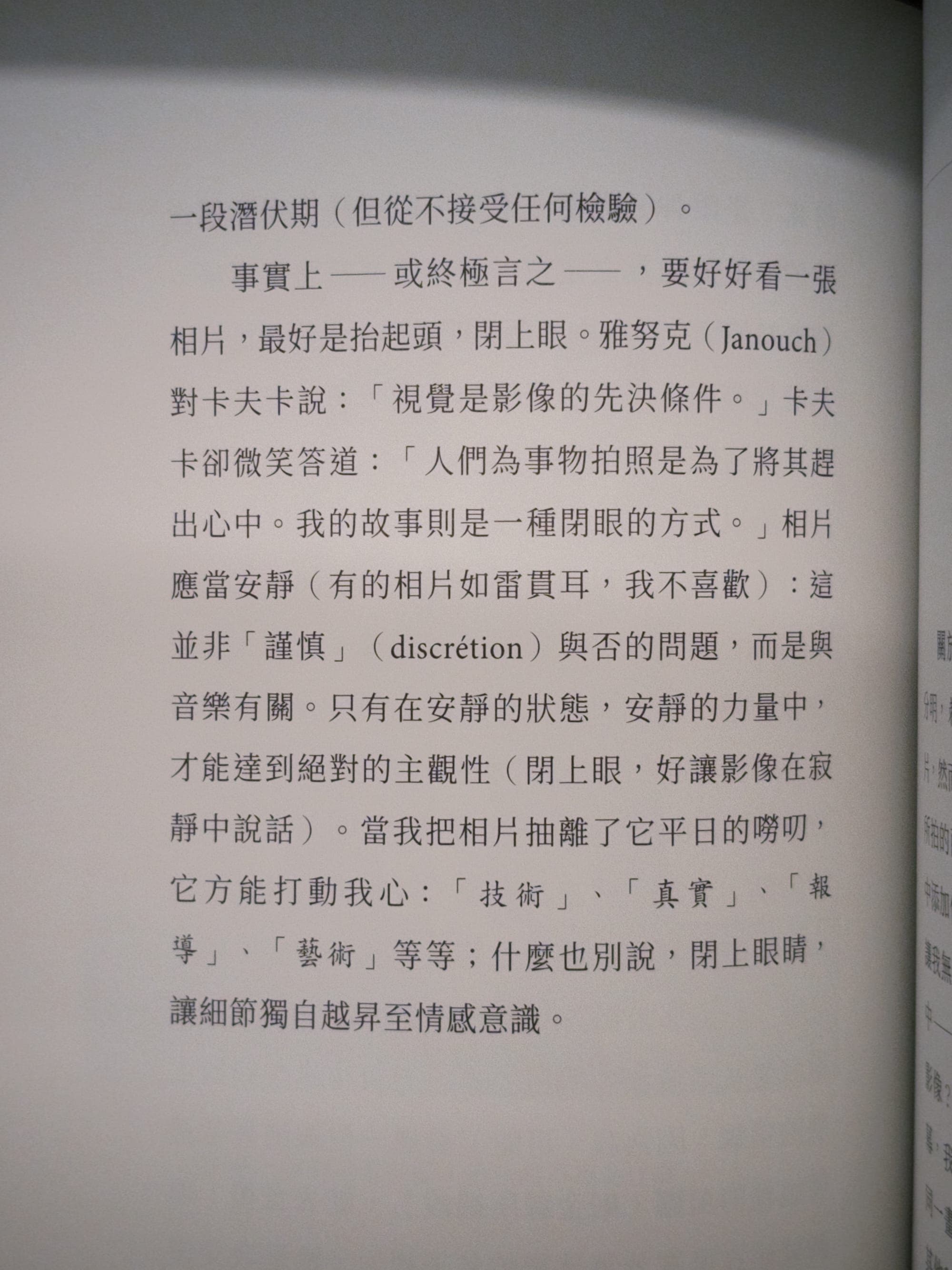
"Presence" is the conclusion I want to draw. The three elements each exist in different forms and with different meanings at the moment a photograph is viewed. The interweaving between them constitutes the Studium and the Punctum.
"The best way to see a photograph clearly is to look up, or close your eyes."
Barthes said this. Through Camera Lucida, Barthes elevates photography to the plane of philosophy and existence, making it no longer just technique or tool, but a medium through which the viewer holds a conversation with the self. Every time we are "struck" by a photograph, we are actually in dialogue with our own memory, emotion, and existence.